
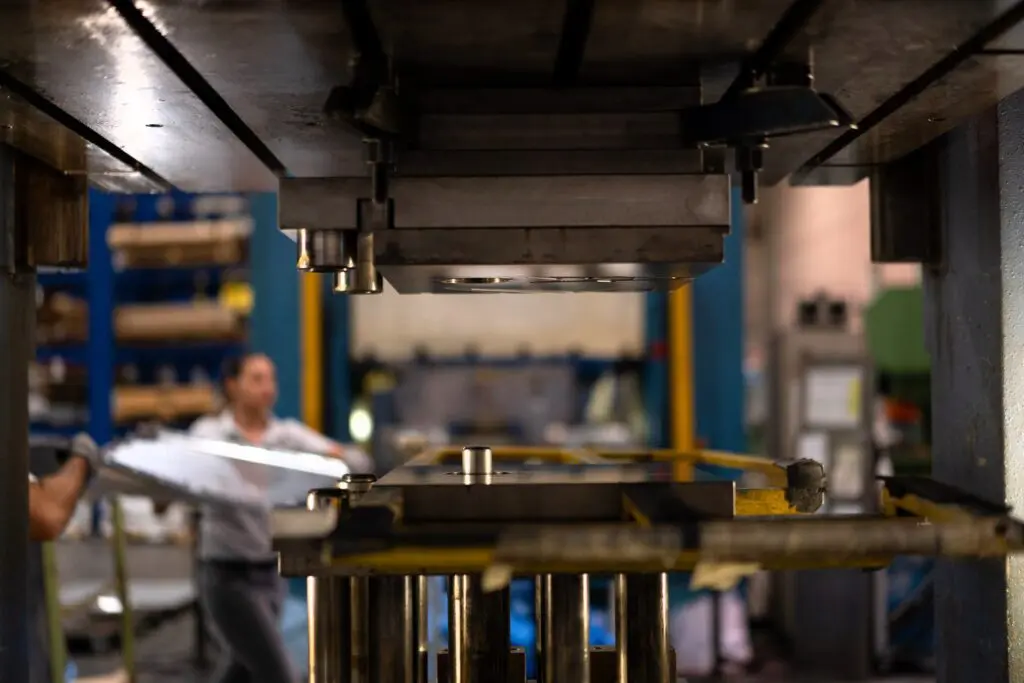
Stainless steel stamping is a manufacturing process that makes it possible to shape metal into specific forms. Geometric profiles, including complex ones, can be produced without excessive material waste, while preserving all the valuable properties of stainless steel.
To perform stamping, advanced machinery is required, along with a deep understanding of the metal and its processing. Each case must be evaluated individually to determine the best options for meeting the specific needs of the target market.
In this article, we will explain in more detail what stainless steel stamping is, its characteristics, advantages, applications, and the differences between hot and cold working processes.
What is stainless steel stamping?
As mentioned earlier, stainless steel stamping is a process that allows the metal to be deformed and/or shaped to achieve a predetermined form through the use of suitable molds, the application of press forces, and the use of other tools applied to the molds (such as punches, for example, which are useful for creating holes, engravings, and embossments).
Stainless steel stamping is carried out on objects of both large and small dimensions, including machine parts or components with varying thicknesses. Cold stamping is often associated with deep drawing, a specific press-working technique that gives the stainless steel sheet a box-like or cup-shaped form.
The advantages of stamping
Stamping enables versatile and cost-effective production of semi-finished products, components, and complex assemblies in large quantities, ensuring speed and efficiency. Thanks to its precision, material waste is minimized, which also helps reduce the overall costs of the entire manufacturing process.
Why use it specifically on stainless steel? Because stainless steel is a resistant, durable, and robust metal, well-suited for this type of process. It enables accurate creations that can be adapted to a wide variety of markets, production needs, and customizations. accurate creations that can be adapted to a wide variety of markets, production needs, and customizations.
Fields of application
Stamping is a precise and rigorous process used across various industries, including food, automotive, petrochemical, and chemical sectors, to name just a few. These are areas where stainless steel is chosen for its undeniable qualities, such as strength, mechanical resistance, and longevity.
However, stainless steel remains a complex material to work with, especially when semi-finished products must meet high-quality standards. This is where a company’s know-how and technological expertise make the difference, which is why Metal’s is chosen by large international groups that need to guarantee the strictest safety and aesthetic standards and operate in sectors such as medical, electromedical, food processing, and Food & Beverage.
In the case of a major Food & Beverage client, stamping proved decisive. The company approached us to manufacture a beverage vending machine for the Middle East, with the goal of reducing production costs without compromising the quality or aesthetics of the final product. We achieved this by proposing dedicated dies, replacing welding with riveting, and introducing new bends to simplify assembly.
Stamping, in fact, has the advantage of reducing material waste. When customized and combined with targeted design solutions, it helps meet a growing need across all industries. cost optimization.
Hot and cold stainless steel stamping: what are the differences?
Typically, stainless steel stamping involves several processing stages, including:
- the creation of a mold that meets the design and shape agreed upon with the client;
- the installation of the mold onto the machine (along with any accessories);
- the loading of the steel sheet ;
- the start of the process, which can take place either hot or cold.
In particular, during hot stamping, the metal sheet is subjected to high temperatures. There are various methods to carry out this process. For example, direct hot stamping involves heating the sheet, transferring it onto a cold mold, and then processing it. In indirect hot stamping, the stainless steel undergoes a “heating” process both before and after stamping. This option is primarily used for creating complex geometries or, with the deep-drawing technique, for deep processes such as making ice cream tubs.
On the other hand, with cold stamping, the material is processed at room temperature. Specifically, when hydraulic machines are used, the stainless steel is placed between the punch and the mold, subjecting the material to the deforming force of the presses, achieving even significant depths. This is a faster process, mainly chosen for the production of small components, in series or with varying thicknesses.o soprattutto per la produzione di componenti di piccole dimensioni, in serie o con spessori differenti.
Stainless steel stamping: cold or hot – which is better?
The choice between these two types of processing can vary depending on whether simple or complex shapes need to be produced. However, it is crucial that this process is performed with precision and expertise. The creation of the mold, in particular, is essential to ensure that every operation is carried out correctly, preventing issues such as production stoppages, waste, and defects in the metal.

Stainless steel stamping: the art of shaping and customizing a component
Stainless steel stamping is a process typically suited for large-scale production and, once the deep-drawing dies are created, proceeds rapidly. Custom-made dies make it possible to produce high-quality, flawless components while significantly speeding up production.
Thanks to stainless steel stamping, customized components can be manufactured in large quantities with precision and maximum reliability.
How we perform stamping at Metal’s
At Metal’s, we have a state-of-the-art machinery park dedicated to stainless steel stamping. Our hydraulic presses offer a force of up to 1,000 tons, while mechanical presses can reach up to 400 tons. These capabilities allow us, when necessary, to carry out deeper, more precise, and larger deep-drawing operations without damaging the material (such as folds or cracks).
Specifically, our equipment includes:
- 1 eccentric press, 20t
- 1 eccentric press, 100t
- 1 SPERTZ mechanical press, 350t, two-column with 1850×1250 beds and 400t blank-holder
- 1 MURARO hydraulic press, 600t, with 1400×1200 beds and 400t blank-holder
- 1 STAMAC hydraulic press, 1000t, with 2500×1400 beds and 500t blank-holder
These advanced and professional technologies enable us to meet the growing demands of clients who require specific designs or custom needs. For example, companies operating in the food industry , producing ovens, dishwashers , and other professional equipment for the catering sector. Regarding the preparation and creation of molds, we can work on existing projects—perhaps suggesting possible improvements and implementations—or develop new ones in collaboration with the client and our team of technicians, optimizing costs and streamlining the process.
Additionally, the client can opt for other treatments such as pickling and passivation (to remove impurities and improve corrosion resistance), or surface treatments like shot peening and satin finishing (to enhance aesthetics), along with final surface cleaning . These processes can be optional or necessary. For the medical sector, for instance, it is essential that surfaces are treated with Brushing, a finish that ensures greater hygienic safety (as indicated in decree no. 269 of December 12, 2007).
This approach is ideal for offering safe productsthat comply with the regulations in the target market and meet all the client’s requirements. At Metal’s, we can evaluate and agree on these treatments together to achieve all the set goals, optimizing the entire process.
Want to learn more?
Most of our processes are highly automated - our machines can operate 24/7- to ensure speed, precision, and minimal waste. For each project, we design custom dies tailored to the order to optimize costs and production. Our goal is to be your single point of contact for the entire process: from sourcing to delivery, including stamping. For this reason, we carefully select the clients we collaborate with and conduct thorough quality checks at every stage of production you want to learn more, read about how Metal’s operates, request our consultancy, and evaluate the benefits for your manufacturing processes.