
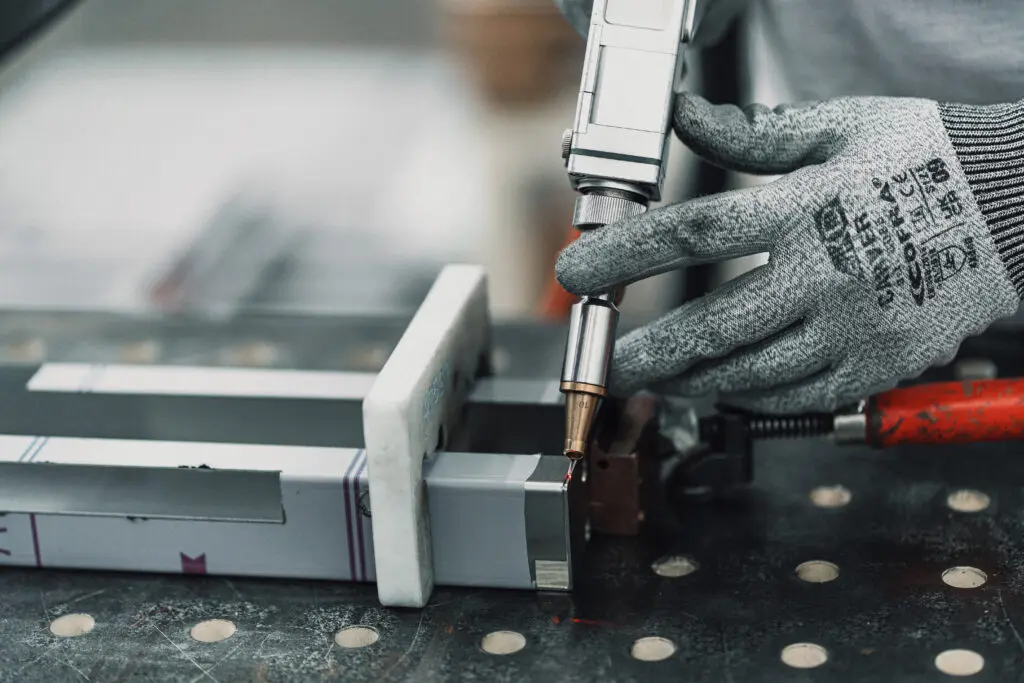
Laser welding is one of the most advanced and versatile technologies currently available for stainless steel processing. At Metal's, we invested in this process years ago, convinced that it represents - and continues to represent - a tangible, measurable advantage for our clients in terms of semi-finished product quality, production efficiency, and cost reduction.
In this article, we examine the benefits of laser welding in detail: when and why to choose it, the certifications that guarantee our work quality, and specific case studies where this technology proved decisive for project success.
What is laser welding and how does it work?
Laser welding is a process that joins stainless steel by melting the metal through the action of a laser beam.
The system directs the beam onto the parts to be joined, generating thermal energy that locally heats and melts the material. Welding can be performed at a single point or continuously along the entire length of the joint.
In both cases, the process is precise, burr-free, and long-lasting.
For these reasons, laser welding is currently the most advanced welding process available, offering numerous advantages.
Let's look at the main ones.
The main advantages of laser welding
Compared to traditional welding processes, laser welding of stainless steel is distinguished by specific characteristics that make it particularly suitable for complex manufacturing, products with delicate stress profiles, and contexts where the aesthetics of the final product are as critical as its functionality.
High precision
The laser operates on a specific, limited area of the material with millimeter-level control over the melting point. This allows for processing even thin gauges while keeping the material as linear and uniform as possible, free from inaccuracies or burrs. This is an essential feature when manufacturing semi-finished products and complex assemblies with unique geometries, or whenever the surface quality of the part must not be compromised.
Reduced heat input
One of the most significant advantages of laser welding is its low heat input. Unlike traditional welding, the laser does not overheat the surfaces, which drastically reduces metal deformation and thermal stress. This is a critical factor in many production processes. Consider, for example, industrial fryers and ovens. These products are subjected to high temperatures, frequent thermal cycles, and repeated washing, requiring welds that are both watertight and highly stress-resistant; laser technology consistently meets all these requirements.
Superior surface finish
Laser welding produces clean joints, free of residue and requiring no further surface finishing. This translates into a tangible and measurable aesthetic improvement: at Metal’s, we have analyzed this aspect in detail, and the results have been highly significant. The transition from traditional to laser welding has led to aesthetic improvements of over 70%. This outcome impacts not only the product's appearance but also its ease of cleaning and sanitization - fundamental requirements for the food, food processing, pharmaceutical, and medical sectors.
Faster processing and reduced waste
Laser welding is faster than traditional TIG or MIG welding and, thanks to its precision, helps reduce material waste and rework. When a weld is not uniform, subsequent surface treatments - such as shot peening - can create microporosities that require costly finishing operations. With laser welding, this risk is virtually eliminated.
When and why choose laser welding
Laser welding is the ideal solution for a wide range of manufacturing applications. Here are some of the areas where we have already tested and successfully implemented it ourselves, as well as the situations in which we recommend it.
The product requires high-level aesthetic finishes
Rotisserie ovens, professional fryers, vending machines, as well as cabinets and hoods for the catering industry: these are all products where aesthetics are an integral part of the finished product's commercial value. Laser welding ensures clean, uniform surfaces, free from the typical marks associated with traditional welding.
When joints must be sealed and free of gaps
In food processing equipment, the presence of gaps or micro-crevices between components can encourage the accumulation of residues and material oxidation, reducing product lifespan and making cleaning operations more difficult. Applied with extreme precision, laser welding effectively and permanently seals these spaces, ensuring superior hygiene and durability.
When materials are thin and geometries are complex
The precise control of the laser beam makes it possible to weld thin materials without causing distortion, making laser welding the preferred technology for delicate components and complex geometries.
Laser welding applications across industrial sectors
At Metal’s, we support leading industrial groups and established companies operating in a wide range of industries. Whenever possible, we recommend process improvements that help optimize production efficiency and reduce costs. Laser welding is one of the solutions we frequently propose. Below are some examples of laser welding applications that our customers have successfully implemented across different sectors.
Food and food processing industry
In the food and food processing industry, laser welding is used in the production of:
- industrial ovens
- deep fryers
- rotisserie systems
- meat processing machines
- shredders
- slicers
- homogenizers and liquid–solid separators
The combination of stainless steel and laser welding ensures hygiene, traceability, and long-term durability, all of which are essential requirements to comply with the most stringent industry regulations.
Medical and pharmaceutical industry
In the medical and pharmaceutical sectors, where hygiene and sanitary requirements are even stricter, laser welding enables the creation of surfaces that are contamination-free, easy to sterilize, and free from areas that are difficult to reach during cleaning.
Packaging and bottling
In the packaging and bottling industry, laser technology enables the production of complex assemblies with high precision, joining components with different geometries and thicknesses while ensuring consistent quality across large production batches.
Metal’s welding certifications
The quality of a weld depends not only on the technology used, but also on the skills of the professionals performing it and the quality control systems ensuring compliance. At Metal’s, we have invested in both aspects:
- Our welders are certified according to UNI EN ISO 9606-1:2017, which confirms their professional qualification and their ability to meet the requirements of the latest industry standards
- The quality of our welds is certified under UNI EN ISO 3834-2:2021, the international benchmark standard for quality requirements in the fusion welding of metallic materials
These certifications demonstrate Metal’s commitment to its customers: large companies operating in international markets and in regulated industries such as food, pharmaceutical, and medical sectors.
Choosing us means relying on a partner that not only manages the entire logistics flow but also guarantees certified, documented welding that complies with the most stringent standards.
Metal’s case studies: when laser welding makes the difference
As previously mentioned, we have successfully proposed laser welding across many sectors and clients. Below are some of our most significant case studies, selected to clearly demonstrate the advantages of this technology.
Industrial fryers and ovens: saving time with automated welding
The first case we want to share is a clear example of the potential of laser welding compared to traditional methods. For an important Food sector client producing fryers and ovens, Metal’s had been performing TIG welding - a process that required long cycle times and resulted in high production costs. After internally testing the new technology, our engineering department proposed switching the client to laser welding, a faster, more precise, and more cost-effective solution. The customer benefited from this transition, achieving improved products both aesthetically and functionally.
To learn more, read the full case study: How we improved production with automated processing
Rotisserie ovens: a 70% improvement in aesthetic quality
For two international clients in the Food Processing sector producing rotisserie ovens and professional fryers, we recommended improving production performance by switching from traditional welding to laser welding. Before making the proposal, we conducted a series of internal tests, pushing the products to their limits in order to assess weld quality, resistance to thermal shocks, and the aesthetic impact of the new process. The results confirmed a 70% improvement in aesthetic quality, along with reduced processing times, lower material waste, and overall cost savings.
To learn more, read the full case history: Technical modifications to improve project performance
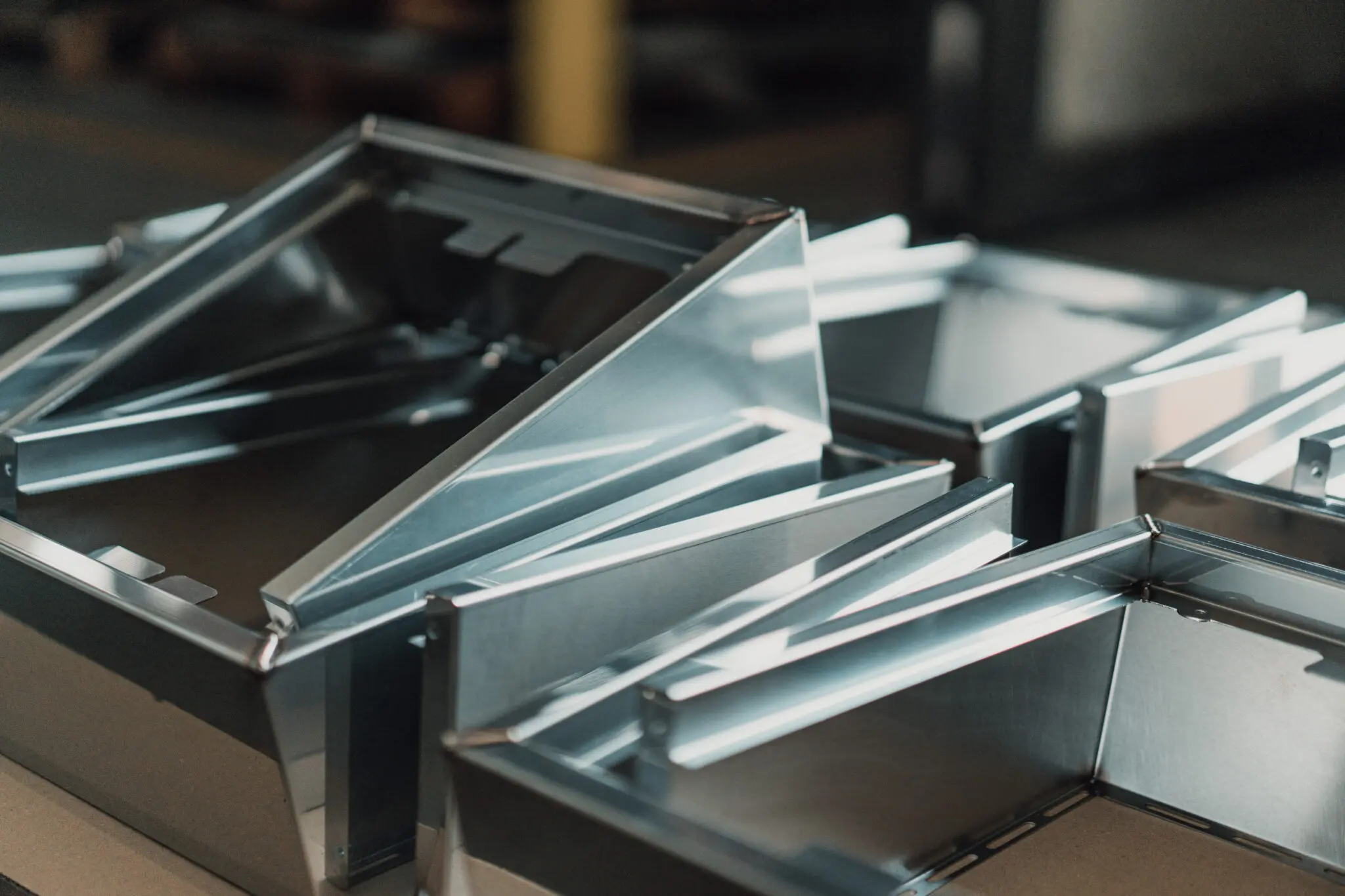
Food processing ovens: certified welding with gap-free joints
We conclude our selection of case studies with an important project for a German client operating in the Food Processing sector, for whom we manufactured ovens with fully sealed welding zones, free of gaps, in three different sizes. The goal was to prevent the accumulation of cooking residues in hard-to-clean areas and extend the product lifecycle. The solution adopted - a robotized laser welding process focused on the functional areas of the components - made it possible to completely eliminate all joint gaps, supporting a continuous production of approximately 6,000 units per year, certified according to UNI EN ISO 3834-2:2021. If you would like to learn more about the client’s requirements and the specific solutions implemented, you can read the full case study: Welding, a certified ISO 3834-2 automated process
Laser welding: an investment in quality and competitiveness
For us, investing in laser welding means improving product quality, reducing production costs, eliminating rework, and therefore ensuring on-time deliveries, in order to meet increasingly stringent market demands, including those related to required certifications.
At Metal’s, we continue to invest in this direction.
Our production facility is constantly expanding, and we rely on 2 kW and 3 kW laser welding systems with filler wire, which complement more traditional welding processes (TIG, MIG, and plasma with computer-controlled power and frequency modulation), allowing us to broaden the range of solutions we offer to our clients.
Would you like to get in touch with us?
At Metal’s, we believe that the best results come from strong and long-lasting relationships. For this reason, we carefully select the clients we collaborate with -medium and large structured companies - with the aim of building profitable, long-term partnerships, supporting them at every stage of the logistical flow: from concept development to the production of assemblies, semi-finished products, and stainless steel machine components.
If you are considering introducing laser welding into your production process, or simply want to understand whether it can make a difference for your project, we are available to evaluate your needs together.
Would you like to learn more?