
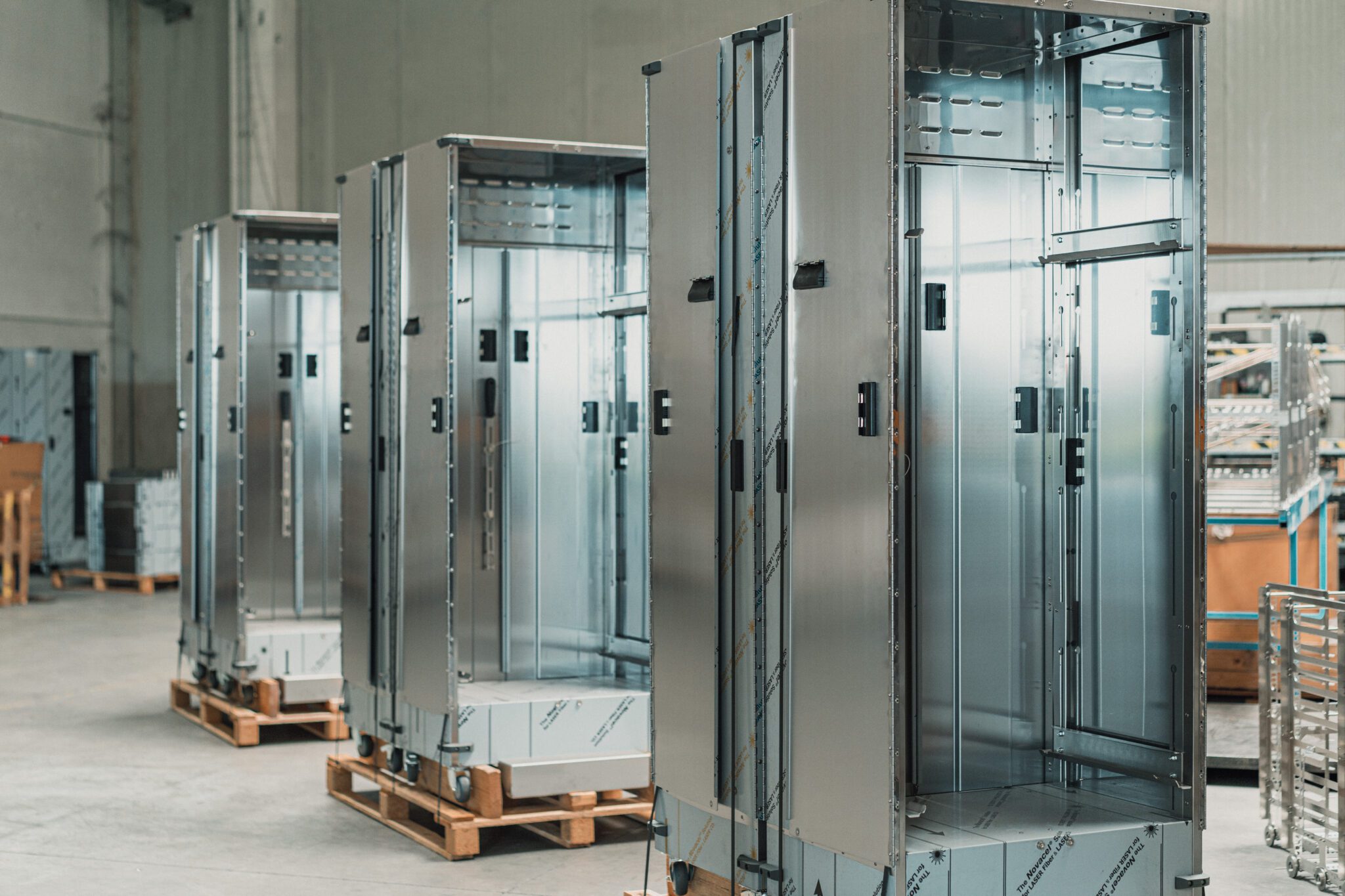
One of the requests we receive more and more often from our customers is to reduce costs without affecting the functionality and aesthetics of the stainless steel semi-finished products and complex assemblies we manufacture for them. That is understandable, given the current international situation and the need to prioritize and rationalize investments.
However, cost reduction is a very complex operation that, at times, can require true reverse engineering. Therefore, it is necessary to review the project in detail and look at it from a different perspective, then find a cheaper but equally effective way to produce.
We could translate all this with an expression often used in Italy: "making the most with what you have", reinventing and improving with the resources available.
This is what happened when a Metal’s customer - a major international group producing baking and pastry systems - asked us to supply cabinets for bread storage and cooling, at very competitive costs and without affecting the technical performance and aesthetics of the product.
Here is how it went.
The challenge: to manufacture the exact same cabinet in Italy while maintaining Eastern European cost
levels
At Metal’s, we know the market for semi-finished products and baking components well and have long produced stainless steel bread storage cabinets designed for Large-Scale Retail (GDO). We know how essential they are for retail chains and, consequently, for their suppliers: they keep production organized and fast-paced, which is why they are supplied to supermarkets as a complement to baking ovens.
This is therefore a strategic product for our customer, and the fear of putting its production at risk was one of the levers that pushed them to ask us to manufacture the cabinet. In fact, until recently, the company sourced the same item from a manufacturer located in Eastern Europe: a long-standing supplier, but one that the geopolitical situation had suddenly placed in a risk situation. The war in Ukraine, in fact, had raised concrete uncertainties about the continuity of supply for such an important component.
If the supplier had interrupted production, even temporarily, our customer would have found themselves without parts in stock.
Therefore, they thought of us and asked us to create the exact same product both in terms of functionality and efficiency and aesthetics, but setting an extremely competitive price target, because it was built on Eastern European standards, where labor costs are significantly lower than in Italy.
Quite a challenge.
Metal’s response: reverse engineering and internal production
Despite Metal’s experience in the production of baking cabinets, soon, analyzing the drawings and the project, we understood that the challenge was much more complex than it seemed at first glance. In fact, to reach the required target, optimizing a few construction details was not enough.
We had to rethink the product systematically, intervening on all necessary aspects to reduce costs, but without changing the functional and aesthetic appearance.
In complex projects like this, every modification, even seemingly small, has an important economic impact, because the slightest variation in the price of a component multiplies its impact and affects the final price significantly. In this specific case, the cabinet components were nearly a hundred, including sheet metal, screws, handles, and gaskets: the meticulous evaluation of every single cost item was crucial!
We therefore rapidly developed a sampling with about fifteen alternative technical solutions, including:
- variations in couplings
- use of special adhesives instead of some welds
- localized electro-pickling instead of immersion
- removal of welds on the doors
- variation of hinges and magnets
But the modifications to the product were only part of the work.
To truly reach the target price, we also had to industrialize the production process and make it more efficient.
For this reason, we automated the welding of the frame on robots - reducing times to a quarter compared to manual processing - and developed dedicated jigs for welding, brushing, and bending, in order to guarantee repeatability and speed even on the most voluminous pieces.
And in order not to wait for the production times of the molds for plastic components - edge
protectors, corners, and wheels - which would have taken about a month, we developed them
internally. Then we used our 3D printer, which allowed us to produce all the components
necessary for the sample in half a day.
A solution that made us totally autonomous in our
supply.
After just one day, the sample was assembled and ready for delivery. Once approved, the customer also homologated all subsequent parts produced using the final molds.
“The customer came to Metal’s to see the sample. He complimented us on the development times - a record, he emphasized - and validated most of the proposed modifications, approving the final solution after about a month of internal functional tests.” - Luca Regazzo, Technical Sales Manager at Metal’s.
Read other cases where, thanks to automation and consultancy, we have reduced company costs for the production of semi-finished products and assemblies.
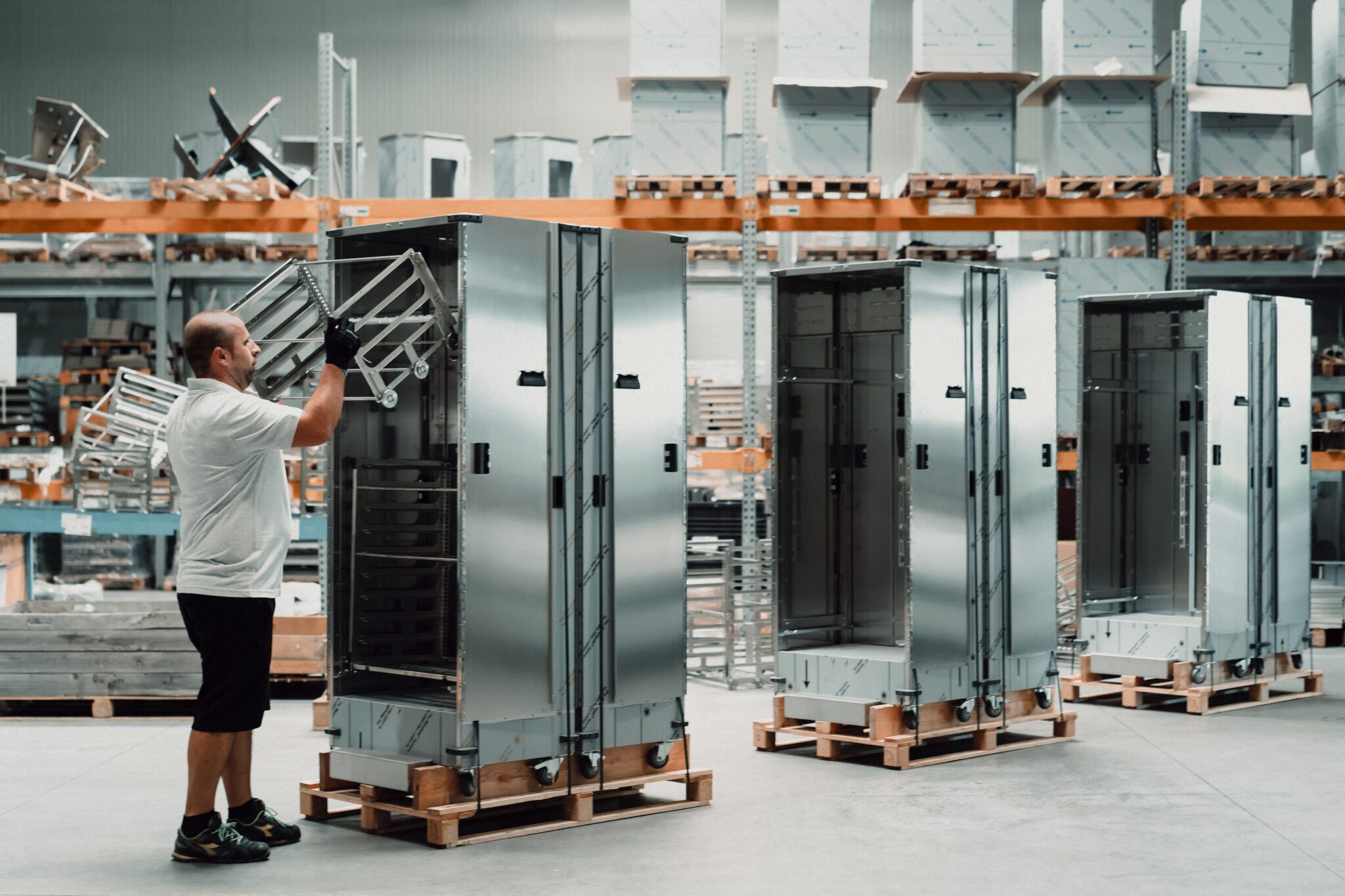
From test to sample, from sample to quantity contract
After the first sampling and the customer's internal tests, we produced two official samples with the final validated solution. Within three weeks of delivery, the customer gave the green light to the quantity agreement. The first batch of 64 cabinets has already been delivered. The second is in processing.
Who we work with, how we work, and where
The story we told you is not just a successful case study, it says something more. It reminds us what Italian industry can do when it works well: find creative solutions while respecting stringent constraints, look at a problem from different angles, bring together technical expertise, execution speed, and production flexibility to reach where others would not. This is what, in our opinion, distinguishes us and which, in this case, made the difference because it allowed us to compete with a supplier with structurally lower costs than ours.
Reverse engineering is an example of how we work at Metal’s.
We aim to be true partners for our customers and not simple suppliers.
We carefully select the customers we collaborate with: medium and large-sized companies, active in sectors requiring high standards and advanced technological processes such as medical and pharma, meat processing and food treatment, bottling and packaging, baking and ovens, coffee shops and professional kitchens, refrigeration, electrical panels, and access control systems, just to name a few. We support them at every stage of the logistics flow: from design and technical consultancy to delivery at place, all over the world.
Born as a local reality, Metal’s has transformed over the years into a global partner, capable of managing the customer's entire supply chain. Our vocation is international. We already serve major groups in Germany, Austria, Switzerland, the Netherlands, Italy, England, and New Zealand, and we are evaluating opportunities in new European markets - Finland, Sweden, Norway, Denmark, France, Spain - and in the United States.
The verticalization in the sectors where we operate allows us to respond promptly to customer requests, identify improvements on already consolidated products or products under design, and suggest them.
As in the case we presented to you, where the solution was not only technical, but industrial, logistical, and strategic at the same time.
Do you want to explore a collaboration with us?