
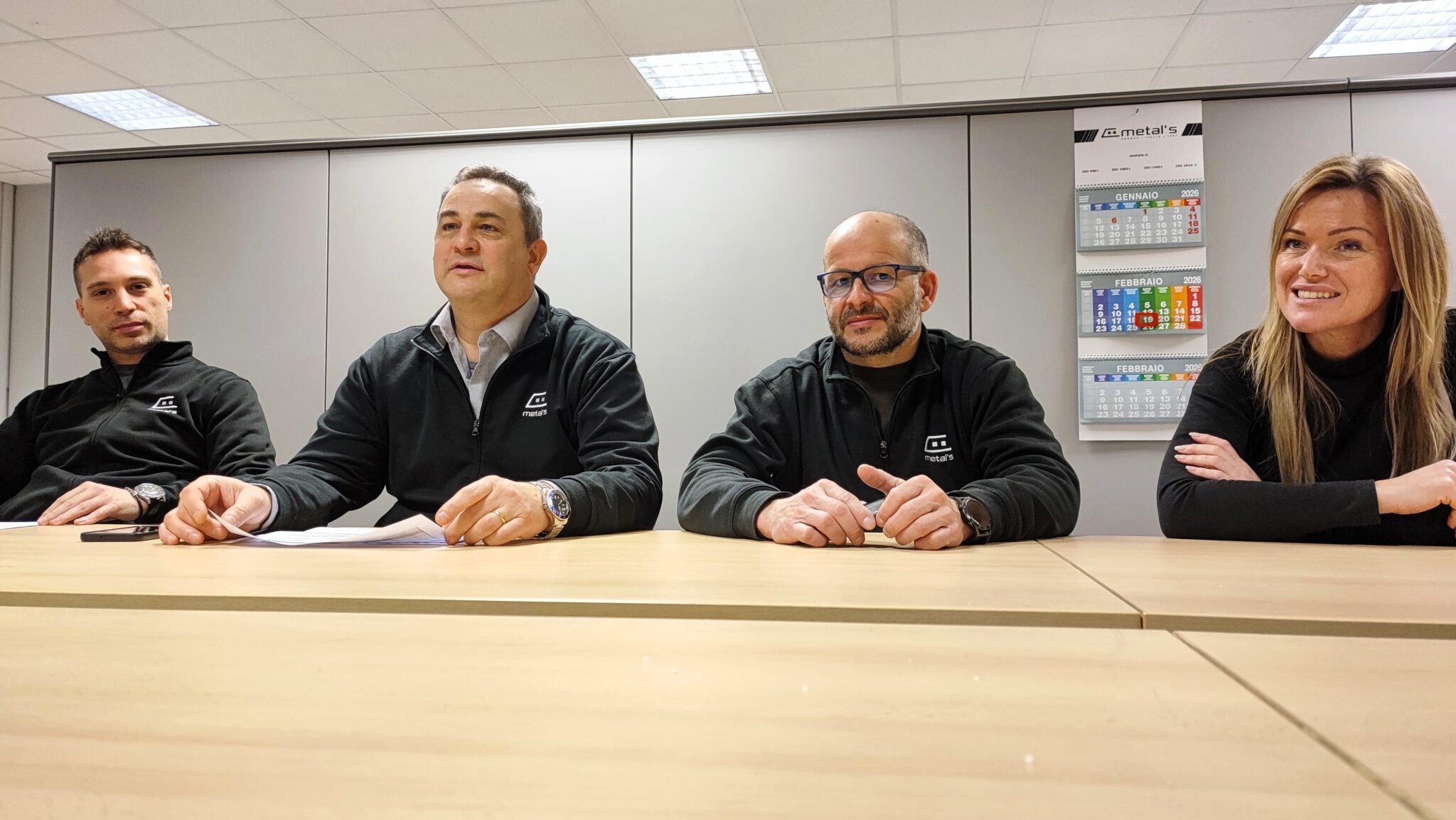
How do you turn an idea into a stainless steel product that meets all the customer’s expectations?
We decided to tell you by interviewing Luca Regazzo, Technical Sales Manager at Metal’s.
Metal’s behind the scenes: what happens when a quote request arrives?
In our articles, we always try to introduce Metal’s to those who are not yet familiar with us. Today, we go into more detail to reveal one of the most important moments for us:
the quote request.
Together with Luca Regazzo, Metal’s Technical Sales Manager, we will explore how the process works that transforms an idea into a product.
Enjoy the read!
It all starts with a technical feasibility analysis and the potential for a lasting relationship
Question: First of all, thank you Luca for your time. We are confident that with your help, it will be easier to explain how
Metal’s approaches the quoting phase and the steps leading to production. Let’s start with the first question:
when a customer request arrives, how is it handled?
Luca Regazzo: I would distinguish two situations: one involving an existing customer and the other a
potential new customer. If it’s a company that already knows us and how we work, everything focuses on a
feasibility analysis starting from the technical drawings, then moving on to preparing the offer.
If it’s a new customer, we also assess the potential to build a long-term, mutually beneficial partnership, with particular attention to economic sustainability for both sides.
Question: So, some requests from potential new customers might not lead to a project, right?
Luca Regazzo: Exactly. I think it’s important to clarify this point because sometimes we receive quote requests for components where stainless steel is not the main material or for producing just a single semi-finished product. Of course, we always discuss the request with the customer and listen carefully. However, if the starting material is not suitable or the order is very small, we prefer to be upfront and let them know we can’t take it on. The reason is that we specialize in stainless steel processing and are not set up for one-off small production runs. our goal is always to establish a long-term relationship with the customer.
Question: So, there’s an initial selection process. Let’s try to create a profile of a Metal’s customer.
Luca Regazzo: Definitely structured companies, often part of international groups, looking for a partner who can guarantee consistent quality, punctuality, and a comprehensive service. We target clients interested in outsourcing repetitive or highly complex processing and who want a product, possibly even finished, ready for customization or integration into their machinery or production line. We are not the right partner for occasional productions or small volumes.
Question: So, a small company asking Metal’s to produce a single piece is not in the target. Is that correct?
Luca Regazzo: Yes. Metal’s is not a company for everyone. In fact, we carefully select who we work with based on the potential business volume and the opportunity to build a long-term collaboration.
Question: So, there is an initial evaluation to understand the technical feasibility of the project starting from the drawings, but also the economic feasibility. Only after this phase is the offer prepared, right?
Luca Regazzo: Exactly. Since we want to build a continuous relationship with our customers, this initial evaluation is the foundation to understand how to structure the offer. It’s also in the interest of those who contact us: presenting an offer only to discover later that the business volume doesn’t meet our objectives wastes everyone’s time. We prefer to clarify these aspects upfront and possibly advise them to turn to other suppliers who are more competitive for small orders.
Sending the offer and quantity contract
Question: What happens once the client accepts the offer?
Luca Regazzo: We analyze the drawings and the specifications requested by the customer, then we send the offer. The offer takes into account all the indicated details: technical features, all the components required - if it’s an assembled or semi-assembled product, such as gaskets, glass parts, plastic components, electrical wiring - and the target price usually provided by the customer. This last piece of information is important because it helps us focus on a specific target.
Question: For which products do you receive the most requests?
Luca Regazzo: In most cases, the requests we receive are for assembled or semi-assembled products: semi-finished goods, complex assemblies, and machine parts for various industrial sectors.
Question: Do you also suggest possible improvements during this phase?
Luca Regazzo: Yes, definitely. Especially when the customer requests an assembled product. Often, the client already provides cost references or preferred materials, but we always reserve the right to propose more efficient or sustainable solutions if we find them. There have been several occasions where the client asked us to reduce production costs, and we ourselves proposed technical alternatives or processes that helped optimize costs.
Question: And what about the suppliers of the individual components that make up the semi-finished product?
Luca Regazzo: Sometimes the client directs us to trusted suppliers for a component’s production, or conversely, we suggest a supplier who is more competitive or of higher quality. Each case is assessed individually, but ultimately it’s the client’s decision which suppliers to use. Our role is not only to produce the part but also to propose improvements.
Question: All this aligns with Metal’s goal of being the sole point of contact for the entire process - from production to logistics.
Luca Regazzo: Exactly. At Metal’s, we manage the entire process - cutting, welding, milling, assembly, up to delivery - and can provide a finished product, not just a part. For the customer, this means having a single contact, guaranteed timelines, quality assurance, and clear costs.
Question: Speaking of ongoing relationships, how does the contractual aspect work?
Luca Regazzo: At Metal’s, we require a sample order and an agreement on quantities. We require a quantity contract where the batch order depends on the successful outcome of the sampling. This way, the client knows that if the sample doesn’t pass, they are not bound to us. But we need guarantees. This brings me back to what I said earlier: this is why we carefully select our clients, because we invest significant resources in machinery and equipment. We must be sure of continuity and business volume.
Question: This obviously also impacts organizational aspects.
Luca Regazzo: Yes. This approach requires a solid structure and precise planning. We have to organize everything in advance—from raw material procurement to assigning production hours to each specific project. Our operators are specialized, and we work by sector. For example, knowing that this year and next, we will be engaged in a certain type of project involving a certain number of welding hours, bending hours, and assembly operator hours allows us to organize and structure accordingly.
Question: Do all Metal’s customers work with quantity contracts?
Luca Regazzo: Yes. Because they know they can rely on guaranteed supply, while we can plan hours, resources, and materials in advance.
Project, render, equipment, sampling
Question: What happens once the client accepts the offer?
Luca Regazzo: We discuss the client’s project, of course. Our role is to suggest technologies, methods, and solutions to realize it, also considering the timelines. For example, recently we supported a client in the electromechanical sector for a production of glass washers to be completed in a very short time. On that occasion, we proposed improvements which the client enthusiastically accepted, and it was very rewarding because it allowed us to work closely together.
Then, returning to our workflow: after the discussion phase, we move on to rendering, equipment preparation, sampling, and from there the whole process starts. Obviously, modifications can occur between these phases, and we are always ready to respond quickly to requests from the client during the process.
Question: How does the technical-commercial office coordinate with the other Metal’s departments during these phases?
Luca Regazzo: The collaboration is daily and direct. Metal’s has more than a hundred employees, but in the offices, we are about twenty. So communications are quick and straightforward. Each project has a single point of contact, so no time is lost retrieving information. When a new order arrives, we always hold a “project meeting” with all the departments involved: technical, commercial, quality, production, and time & methods. This discussion is fundamental because often new ideas, technical improvements, or adjustments emerge from the different skills, making the product more efficient.
Question: Is it possible for the client to visit Metal’s facility?
Luca Regazzo: Absolutely. We often receive delegations from our clients who come for audits. In fact, it’s precisely on these occasions that companies appreciate even more how we work at Metal’s because they can see our approach firsthand.
Question: One last question: what is the human value of Metal’s technical-commercial team?
Luca Regazzo: Competence, focus, and straightforwardness. At Metal’s, nobody works in silos. Even though each of us has a specific role, there is always collaboration, open discussion, and a desire to improve. This definitely makes you feel part of a great team!
Want to get in touch with us?
At Metal’s, we believe that the best results come from strong and lasting relationships. That’s why we carefully select our clients, aiming to build profitable and long-term collaborations. Interested in learning more?