
Sustainability is a commitment that we, at Metal’s, have strongly felt for a long time. Years ago, we decided to reduce our company’s environmental impact, starting with small daily actions and moving up to major investments, such as in photovoltaic systems and the adoption of hybrid machinery. This approach has now reached its most mature expression in our first Sustainability Plan: a project launched in 2024 as part of our two-year sustainable development plan, which gives even more concrete substance to Metal’s Green Mission.
Sustainability at Metal’s: a journey that comes from afar
It all started with good habits: waste sorting, the reduction of plastic packaging, and a strong focus on production waste. Small steps that, over time, have built a corporate culture geared toward environmental responsibility.
From there, we moved on to more structured and ambitious investments. The first and most significant of these is undoubtedly the installation of photovoltaic panels, followed by the adoption of hybrid machinery, the introduction of a nitrogen generator and, at the heart of it all, the implementation of an environmental management system certified to the ISO 14001 standard.
All of these investments have enabled us to produce green energy, significantly reduce our CO2 emissions, and achieve near-total energy independence.
The second step: measuring our Carbon Footprint
The next step was to measure our environmental impact. In 2024, we began measuring Metal’s Carbon Footprint - meaning the amount of CO2 emitted directly and indirectly by our activities - to obtain a precise and objective snapshot of our situation.
The analysis did not stop at Metal’s alone, as a company’s environmental footprint affects the entire supply chain. In fact, we also involved our suppliers, calling on them to demonstrate their own commitment to environmental sustainability.
From the Carbon Footprint to the sustainability plan
Before drafting the sustainability plan, we wanted to understand what truly matters to us and to those around us. This process developed across several phases.
Materiality analysis
We conducted a materiality analysis following the principles of Directive (EU) 2022/2464 (Corporate Sustainability Reporting Directive – CSRD) and the European Sustainability Reporting Standards (ESRS). The foundational criterion is double materiality: impact materiality and financial materiality. On one hand, we analyzed the impact that our activities generate on the environment and society; on the other hand, we assessed what ESG factors mean for our business.
The process involved the direct engagement of internal and external stakeholders - employees, customers, suppliers, and other key partners - whom we asked to evaluate the relevance and likelihood of impact of the core sustainability topics.
This assessment provided us with a priority map on which to focus our actions and investments, which ultimately enabled us to build our sustainability plan.
Defining priorities and targets
We have identified the most relevant sustainability areas for Metal’s to effectively guide our financial, managerial, and organizational resources. Subsequently, measurable targets were set to be achieved over the short, medium, and long term, starting with the contribution that Metal’s intends to make to the Sustainable Development Goals (SDGs) of the 2030 Agenda - the framework adopted in 2015 by the 193 UN member states to promote a sustainable growth model globally.
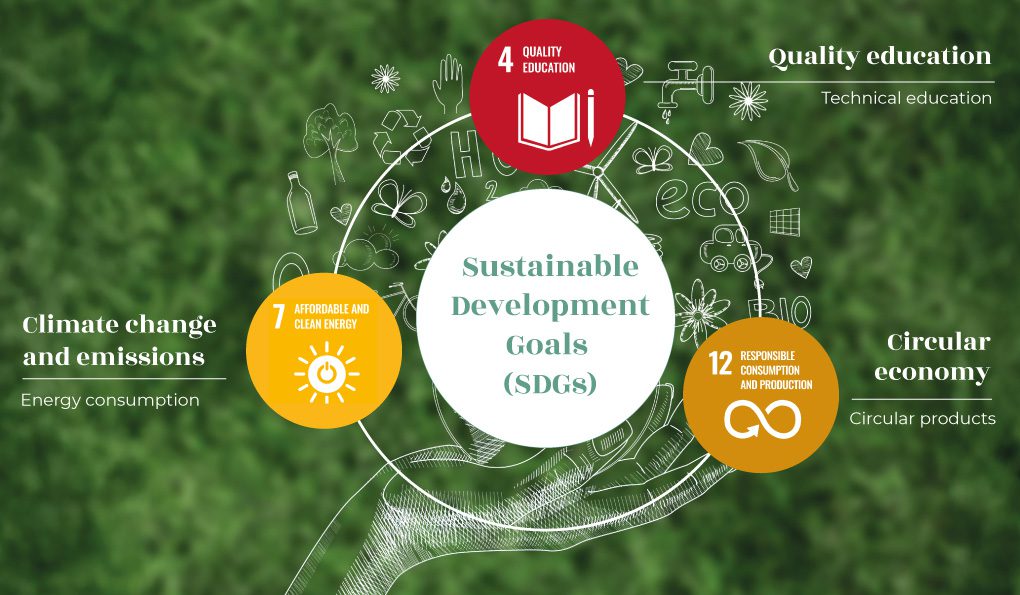
Among the 17 SDGs and their 169 targets, we have identified those most aligned with our activities and vision. In particular, Metal’s actively contributes to several of these through concrete actions and targeted investments:
SDG 4 – Quality education
We believe that a company’s growth stems first and foremost from its people. For this reason, also thanks to the Metal's Academy, we have launched structured training programs designed to develop technical and soft skills, with a long-term vision focused on both the professional development and personal growth of our employees.
SDG 7 – Affordable and clean energy
The energy transition is one of the pillars of our commitment. Investments in photovoltaic systems and more efficient machinery have allowed us to tangibly reduce energy consumption and emissions related to our production activities, moving us closer to an increasingly responsible management of energy resources.
SDG 12 – Responsible consumption and production
Rethinking the production cycle through a circular lens is a priority for us. From waste reduction to material recovery, we work to minimize waste and adopt more conscious consumption practices, in line with the principles of the circular economy.
For each of these goals, the sustainability plan defines specific KPIs (Key Performance Indicators) and operational actions, with clear and verifiable timeframes. This approach allows us to monitor progress over time and transparently report on the results achieved.
Roadmap and governance
We have built a detailed action plan, directly involving the various functions within Metal’s - management and heads of the main business areas - with the aim of:
- gathering qualitative information
- identifying distinctive elements and the development lines to pursue
- establishing the initiatives to be implemented in the short, medium, and long term
To this end, an internal team has been appointed within Metal’s to oversee and monitor the process, ensuring that the plan is managed correctly and that cross-functional coordination is achieved, since sustainability is the common thread connecting all company areas.
This oversight currently helps us maintain control over the initiatives undertaken and will be essential in the future for reporting in accordance with the provisions of the CSRD.
Formalizing the plan into a structured and integrated document
All the work carried out - the analyses, the interviews, and the goals - has come together into an integrated and structured document: the sustainability plan. This is an operational tool that allows us to monitor and demonstrate Metal’s commitment to sustainability to our customers, designed to be updated over time and to evolve alongside the company.
The plan is structured around two pillars - environmental and social - within which we have identified the priority areas for focusing actions, investments, and resources over the medium-to-long term. For each area, we have defined clear timeframes: short-term within one year, medium-term within three years, and long-term within five years. Each goal is backed by specific operational actions and monitoring KPIs to measure interim progress and verify alignment with the established strategy.
Would you like to get in touch with us?
For Metal’s, integrating sustainability into corporate management means combining production efficiency, environmental awareness, and the development of our people - an approach we share with our customers and partners.
If your company is looking for a partner specialized in stainless steel processing, is well-structured, medium-to-large in size, and, like us, focuses on sustainability with the goal of establishing long-term, ongoing collaborations, we are at your disposal to analyse your needs together.
Would you like to learn more?